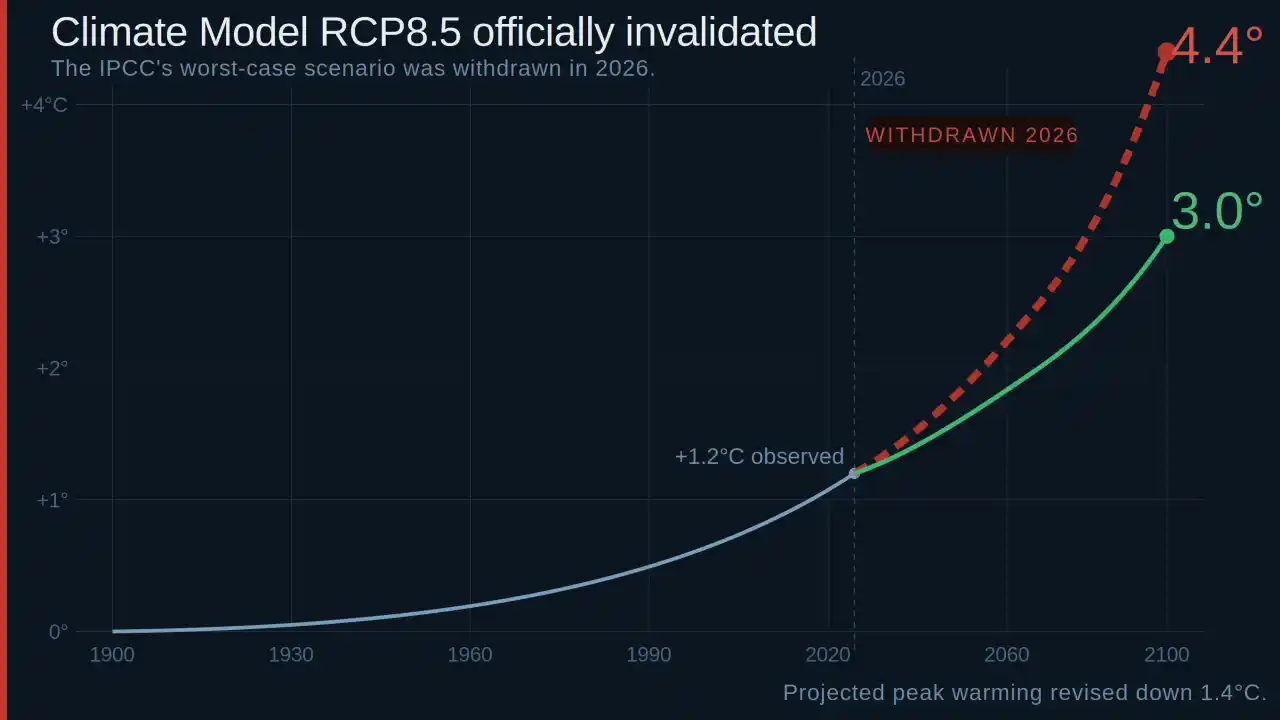
The climate model known as RCP8.5, long promoted as the ‘business-as-usual’ climate scenario, has been officially declared implausible by the international committee responsible for the Intergovernmental Panel on Climate Change (IPCC) climate scenarios.
The new CMIP7 framework has eliminated RCP8.5 and SSP5-8.5, acknowledging that high-end emissions levels “have become implausible” given renewable energy trends and emerging climate policy.1
Tens of thousands of research papers, government regulations, and financial stress tests were built on carbon dioxide emissions assumptions that described an impossible future.2
The new highest scenario projects end-of-century warming approximately 1.4 degrees Celsius lower than RCP8.5, a fundamental reduction in the projected upper bound of climate risk.
Short Summary:
For more than a decade, Representative Concentration Pathway 8.5 (RCP8.5) dominated climate research and policy as the “business-as-usual” pathway, projecting global temperatures rising 4 degrees Celsius or more by 2100.3 Thousands of research papers using RCP 8.5 high temperature projections were published forecasting ever worsening, extreme climate impacts. Public policies were shaped in response to RCP 8.5’s projections.
That scenario is now officially dead. In April 2026, the IPCC committee published its new Coupled- Model Intercomparison Project 7 (CMIP7), a global climate science initiative under the World Climate Research Program (WCRP) that coordinates and standardizes climate computer models, explicitly eliminated RCP8.5 and SSP5-8.5, conceding that their emissions projections implausible. The climate research, projections, and policies built on these scenarios must now be reassessed as thousands of research papers, regulations, and policies based on RCP8.5 are now invalidated.
Why Was RCP8.5 Fundamentally Flawed?
Implausible coal assumptions: RCP8.5 required roughly a five-fold increase in global coal consumption by 2100, inconsistent with declines in cost and government support for renewable energy, natural gas displacement, and widespread coal phase-out policies.4
Inflated demographics: The scenario assumed a 2100 global population of 12.6 to 14.5 billion, far above credible projections. Analysis shows that replacing the SSP3 demographic trajectory with a realistic one alone reduces projected warming by approximately 0.6 degrees Celsius.
Misrepresented as business-as-usual, RCP8.5 was routinely described as the default future without climate policy. In reality, real-world carbon dioxide emissions from 2005 to 2020 tracked far below RCP8.5 levels even without major climate legislation in place.
What the New CMIP7 Framework Shows
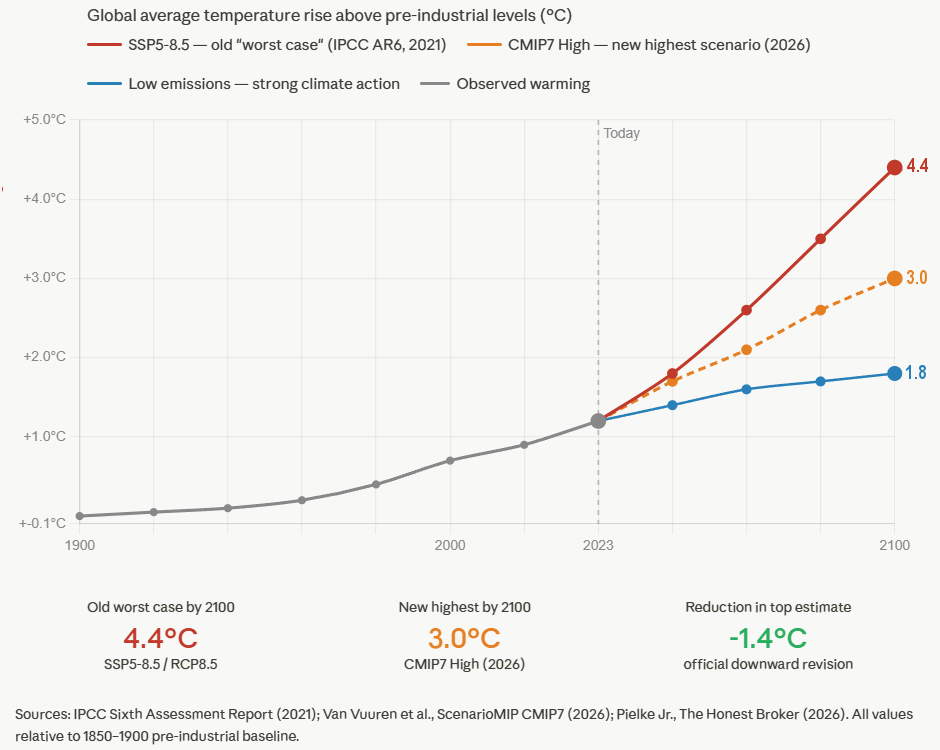
The new IPCC model scenario reaches roughly 80 Gigatons (Gt) of carbon dioxide released into the atmosphere per year in 2100, far below the old SSP5-8.5 at 128 Gt. Nothing in the new model comes close to the old worst case. Projected end-of-century warming under the new CMIP7 high scenario is approximately 3.0 degrees Celsius, about 1.4 degrees Celsius cooler than the IPCC’s previously published SSP5-8.5 value of 4.4 degrees. As seen in Figure 1 below.
Figure 1. A comparison of the old, new, and low emissions models added to the observed warming from 1900 to 2023. Graphic by A. Watts from original data.
The new framework explicitly acknowledges the highest-level scenario is not a business-as-usual scenario but an exploratory thought experiment about the upper bound of possible emissions. Even the new medium level scenario likely overstates risk: its post-2050 emissions run 18 percent higher than the previous middle-of-the-road scenario, and the International Energy Agency ‘s current-policy trajectory falls well below it.5
Why This Matters: Policy and Regulatory Fallout
RCP8.5 was embedded in the policies of the world’s largest economies and financial institutions. The U.S. National Climate Assessments, plus others, relied on RCP8.5.6 The Federal Reserve Bank of New York calibrated its “Climate Stress Testing” to RCP8.5, mirroring climate risk assessments of other banks.7 The World Bank’s Climate Change Knowledge Portal, used for 100+ client countries, defaulted to SSP5-8.5.8
As Pielke wrote: “We now know that all of this is built on a foundation of sand.”
The climate model known as RCP8.5, long promoted as the ‘business-as-usual’ climate scenario, has been officially declared implausible by the international committee responsible for the Intergovernmental Panel on Climate Change (IPCC) climate scenarios.
The new CMIP7 framework has eliminated RCP8.5 and SSP5-8.5, acknowledging that high-end emissions levels “have become implausible” given renewable energy trends and emerging climate policy.1
Tens of thousands of research papers, government regulations, and financial stress tests were built on carbon dioxide emissions assumptions that described an impossible future.2
The new highest scenario projects end-of-century warming approximately 1.4 degrees Celsius lower than RCP8.5, a fundamental reduction in the projected upper bound of climate risk.
Short Summary:
For more than a decade, Representative Concentration Pathway 8.5 (RCP8.5) dominated climate research and policy as the “business-as-usual” pathway, projecting global temperatures rising 4 degrees Celsius or more by 2100.3 Thousands of research papers using RCP 8.5 high temperature projections were published forecasting ever worsening, extreme climate impacts. Public policies were shaped in response to RCP 8.5’s projections.
That scenario is now officially dead. In April 2026, the IPCC committee published its new Coupled- Model Intercomparison Project 7 (CMIP7), a global climate science initiative under the World Climate Research Program (WCRP) that coordinates and standardizes climate computer models, explicitly eliminated RCP8.5 and SSP5-8.5, conceding that their emissions projections implausible. The climate research, projections, and policies built on these scenarios must now be reassessed as thousands of research papers, regulations, and policies based on RCP8.5 are now invalidated.
Why Was RCP8.5 Fundamentally Flawed?
Implausible coal assumptions: RCP8.5 required roughly a five-fold increase in global coal consumption by 2100, inconsistent with declines in cost and government support for renewable energy, natural gas displacement, and widespread coal phase-out policies.4
Inflated demographics: The scenario assumed a 2100 global population of 12.6 to 14.5 billion, far above credible projections. Analysis shows that replacing the SSP3 demographic trajectory with a realistic one alone reduces projected warming by approximately 0.6 degrees Celsius.
Misrepresented as business-as-usual, RCP8.5 was routinely described as the default future without climate policy. In reality, real-world carbon dioxide emissions from 2005 to 2020 tracked far below RCP8.5 levels even without major climate legislation in place.
What the New CMIP7 Framework Shows
The new IPCC model scenario reaches roughly 80 Gigatons (Gt) of carbon dioxide released into the atmosphere per year in 2100, far below the old SSP5-8.5 at 128 Gt. Nothing in the new model comes close to the old worst case. Projected end-of-century warming under the new CMIP7 high scenario is approximately 3.0 degrees Celsius, about 1.4 degrees Celsius cooler than the IPCC’s previously published SSP5-8.5 value of 4.4 degrees. As seen in Figure 1 below.
Figure 1. A comparison of the old, new, and low emissions models added to the observed warming from 1900 to 2023. Graphic by A. Watts from original data.
The new framework explicitly acknowledges the highest-level scenario is not a business-as-usual scenario but an exploratory thought experiment about the upper bound of possible emissions. Even the new medium level scenario likely overstates risk: its post-2050 emissions run 18 percent higher than the previous middle-of-the-road scenario, and the International Energy Agency ‘s current-policy trajectory falls well below it.5
Why This Matters: Policy and Regulatory Fallout
RCP8.5 was embedded in the policies of the world’s largest economies and financial institutions. The U.S. National Climate Assessments, plus others, relied on RCP8.5.6 The Federal Reserve Bank of New York calibrated its “Climate Stress Testing” to RCP8.5, mirroring climate risk assessments of other banks.7 The World Bank’s Climate Change Knowledge Portal, used for 100+ client countries, defaulted to SSP5-8.5.8
As Pielke wrote: “We now know that all of this is built on a foundation of sand.”
We use cookies to ensure that we give you the best experience on our website. If you continue to use this site we will assume that you are happy with it.