Alaska’s extremely cold nighttime temperatures have moderated over the period of record, resulting in less deadly conditions for human health.
There is no discernable long-term trend in precipitation – different parts of the state have seen diverse trends in annual snowfall.
Wildfires have not become worse since at least 2001.
Relative sea level is falling, not rising, along most of the state’s coastlines.
Growing seasons have lengthened and crop yields have increased during the past century.
Short Summary:
Temperature Trends:
Alaska is by far the largest state and has a variety of climate regions because of its topography. It is dominated by what Köppen-Geiger classifies as subarctic with cool summers.1
Average Alaskan temperatures have risen approximately 3°F since 1925.2 This is driven primarily by higher minimum temperatures, especially during the frigid winter, not “higher highs.” One explanation for this is the urban heat island effect, which is closely related to population growth. Research suggests that up to 65 percent of the observed warming can be attributed to urbanization.3 Alaska’s warming trend did not begin until the late 1970s, which corresponds to a population boom around that time resulting in the state’s population more than doubling over just a few decades.4
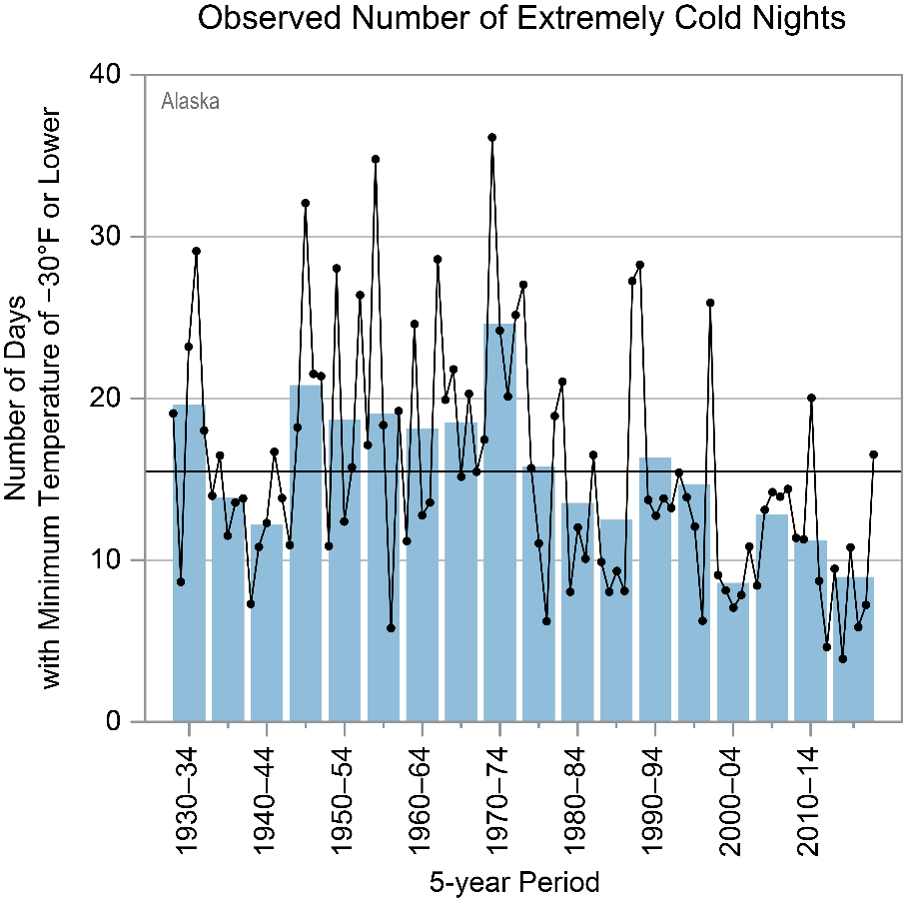
The number of “extremely cold” nights (minimum temperatures -30°F or lower) has declined since the 1930s, which is beneficial for human health, as cold weather kills many more people every year than hot weather does.5 (See figure below)
Figure 1: Observed number of extremely cold nights in Alaska from 1930 to 2020. Dots are annual values; bars are averages of 5-year periods with the last bar representing 6 years. Horizontal line is the long-term average. Chart source: Stewart, Brooke C. et al, “Alaska State Climate Summary,” NOAA.
It must be noted that most of Alaska is very remote and underpopulated, with vast areas having no weather recording stations for long record periods. This means the average temperature trend record is dominated by urban temperature stations. For example, the “extremely cold nights” data comes from just 10 long-term reporting stations. Reliable temperature data only goes back to the 1920s, as opposed to 1900 or earlier for the rest of the United States.
Precipitation:
There has been little change in long term precipitation patterns in Alaska, seasonally or annually, though recent decades have seen slightly fewer precipitation events that are classified as “extreme.”6
Long term drought data for Alaska is limited, but since 2001 there has been no change in the trend of drought frequency or severity.7
State-Specific Issues:
Wildfires
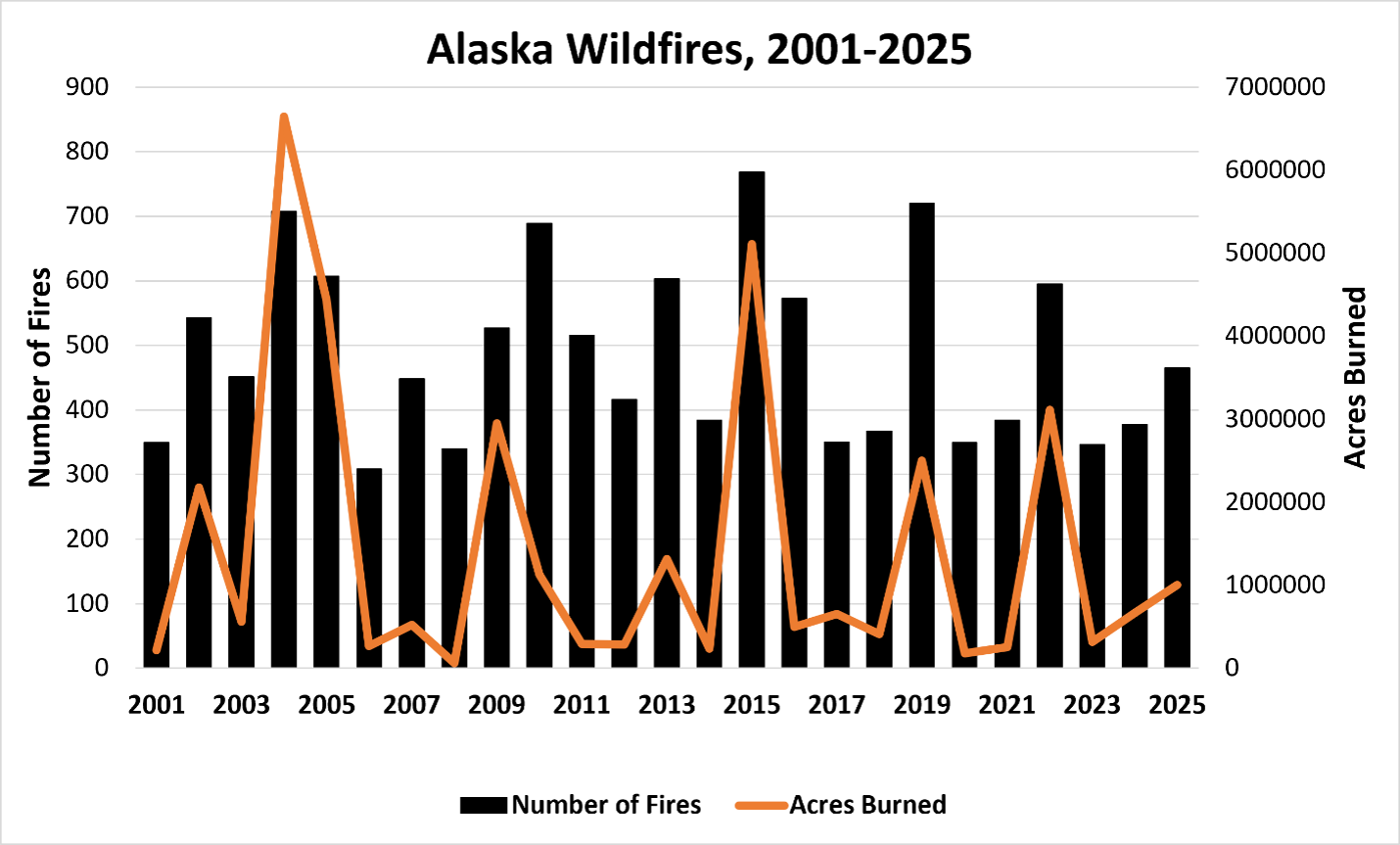
Alaska often experiences wildfires. However, data from the National Interagency Coordination Center indicate there is no trend in wildfire size or incidence since consistent data began in 2001.8 (See figure below)
Figure 2: Wildfire number and acreage burned in Alaska 2001-2025. Data from the National Interagency Coordination Center.
Snow
Annual snowfall in Alaska is impacted by the El Niño Southern Oscillation and the longer Pacific Decadal Oscillation, among other regional patterns. Records indicate that annual snowfall has slightly declined in Southeast Alaska since the 1970s, particularly the lower lying parts of coastal Alaska.9 However, in 2026, Juneau recorded its coldest, snowiest winter on record.10
Other parts of Alaska do not show the same trend; the North Slope and parts of the Interior show an increase in snowfall, and much of the change since the 1970s is within natural variability.11
Sea Level Rise
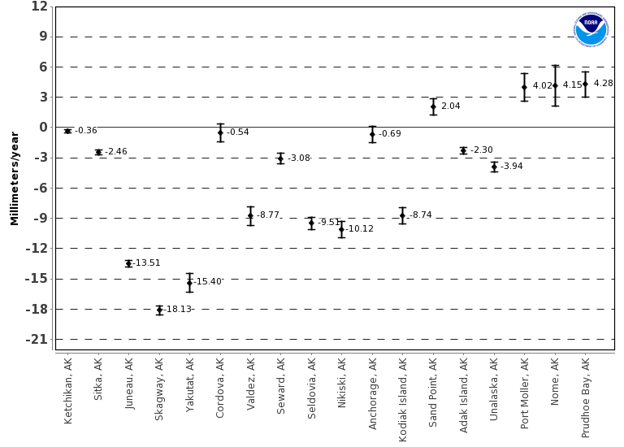
Most of Alaska’s coastline has seen significant decline, not rise, in relative sea level, largely due to land rising.12 (See figure below)
Figure 3: Relative sea level at Alaska tide gauge stations, chart from: “Relative Sea Level Trends for Northern Pacific,” National Oceanic and Atmospheric Administration.
Agriculture:
Despite being the largest state in the United States by land area, Alaska has one of the smallest and least productive agricultural sectors due to the cold climate and greatly relies on imports and greenhouse produce. Field crops that survive colder conditions, like hay and barley, saw production increase by 135 percent,13 and 71 percent,14 over their respective data ranges (1960-2025 and 1993-2025).
Data indicates that the length of Alaska’s crop growing season has increased by about 32 days in some regions since 1911, making it possible to grow a greater variety of crops as modest warming has occurred.15
Conclusion:
Alaska is benefitting from slight warming, especially when it comes to fewer extremely cold nights and a lengthening of growing seasons. Wildfires and drought have not worsened, and while snow trends differ based on region, there has been no consistent decline in snow across the state; some regions have experienced less snow and others have received more.
“Urban Heat Island Effects in U.S. Summer Surface Temperature Data, 1895–2023,” Spencer, Roy W., John R. Christy, and William D. Braswell, Journal of Applied Meteorology and Climatology, https://doi.org/10.1175/JAMC-D-23-0199.1
Alaska’s extremely cold nighttime temperatures have moderated over the period of record, resulting in less deadly conditions for human health.
There is no discernable long-term trend in precipitation – different parts of the state have seen diverse trends in annual snowfall.
Wildfires have not become worse since at least 2001.
Relative sea level is falling, not rising, along most of the state’s coastlines.
Growing seasons have lengthened and crop yields have increased during the past century.
Short Summary:
Temperature Trends:
Alaska is by far the largest state and has a variety of climate regions because of its topography. It is dominated by what Köppen-Geiger classifies as subarctic with cool summers.1
Average Alaskan temperatures have risen approximately 3°F since 1925.2 This is driven primarily by higher minimum temperatures, especially during the frigid winter, not “higher highs.” One explanation for this is the urban heat island effect, which is closely related to population growth. Research suggests that up to 65 percent of the observed warming can be attributed to urbanization.3 Alaska’s warming trend did not begin until the late 1970s, which corresponds to a population boom around that time resulting in the state’s population more than doubling over just a few decades.4
The number of “extremely cold” nights (minimum temperatures -30°F or lower) has declined since the 1930s, which is beneficial for human health, as cold weather kills many more people every year than hot weather does.5 (See figure below)
Figure 1: Observed number of extremely cold nights in Alaska from 1930 to 2020. Dots are annual values; bars are averages of 5-year periods with the last bar representing 6 years. Horizontal line is the long-term average. Chart source: Stewart, Brooke C. et al, “Alaska State Climate Summary,” NOAA.
It must be noted that most of Alaska is very remote and underpopulated, with vast areas having no weather recording stations for long record periods. This means the average temperature trend record is dominated by urban temperature stations. For example, the “extremely cold nights” data comes from just 10 long-term reporting stations. Reliable temperature data only goes back to the 1920s, as opposed to 1900 or earlier for the rest of the United States.
Precipitation:
There has been little change in long term precipitation patterns in Alaska, seasonally or annually, though recent decades have seen slightly fewer precipitation events that are classified as “extreme.”6
Long term drought data for Alaska is limited, but since 2001 there has been no change in the trend of drought frequency or severity.7
State-Specific Issues:
Wildfires
Alaska often experiences wildfires. However, data from the National Interagency Coordination Center indicate there is no trend in wildfire size or incidence since consistent data began in 2001.8 (See figure below)
Figure 2: Wildfire number and acreage burned in Alaska 2001-2025. Data from the National Interagency Coordination Center.
Snow
Annual snowfall in Alaska is impacted by the El Niño Southern Oscillation and the longer Pacific Decadal Oscillation, among other regional patterns. Records indicate that annual snowfall has slightly declined in Southeast Alaska since the 1970s, particularly the lower lying parts of coastal Alaska.9 However, in 2026, Juneau recorded its coldest, snowiest winter on record.10
Other parts of Alaska do not show the same trend; the North Slope and parts of the Interior show an increase in snowfall, and much of the change since the 1970s is within natural variability.11
Sea Level Rise
Most of Alaska’s coastline has seen significant decline, not rise, in relative sea level, largely due to land rising.12 (See figure below)
Figure 3: Relative sea level at Alaska tide gauge stations, chart from: “Relative Sea Level Trends for Northern Pacific,” National Oceanic and Atmospheric Administration.
Agriculture:
Despite being the largest state in the United States by land area, Alaska has one of the smallest and least productive agricultural sectors due to the cold climate and greatly relies on imports and greenhouse produce. Field crops that survive colder conditions, like hay and barley, saw production increase by 135 percent,13 and 71 percent,14 over their respective data ranges (1960-2025 and 1993-2025).
Data indicates that the length of Alaska’s crop growing season has increased by about 32 days in some regions since 1911, making it possible to grow a greater variety of crops as modest warming has occurred.15
Conclusion:
Alaska is benefitting from slight warming, especially when it comes to fewer extremely cold nights and a lengthening of growing seasons. Wildfires and drought have not worsened, and while snow trends differ based on region, there has been no consistent decline in snow across the state; some regions have experienced less snow and others have received more.
“Urban Heat Island Effects in U.S. Summer Surface Temperature Data, 1895–2023,” Spencer, Roy W., John R. Christy, and William D. Braswell, Journal of Applied Meteorology and Climatology, https://doi.org/10.1175/JAMC-D-23-0199.1
We use cookies to ensure that we give you the best experience on our website. If you continue to use this site we will assume that you are happy with it.