Georgia has seen a decline in extreme heat, including fewer days with temperatures 100°F or higher.
Average temperatures have risen at only half the national rate.
Hurricane strikes have not increased, nor have wildfires.
Major cash crops like peanuts have seen massive increases in yields over time.
Short Summary:
Temperature Trends:
Georgia is dominated by a humid subtropical climate, according to Köppen classification. It has short, mild winters and hot, humid summers, with little difference in precipitation between seasons.1
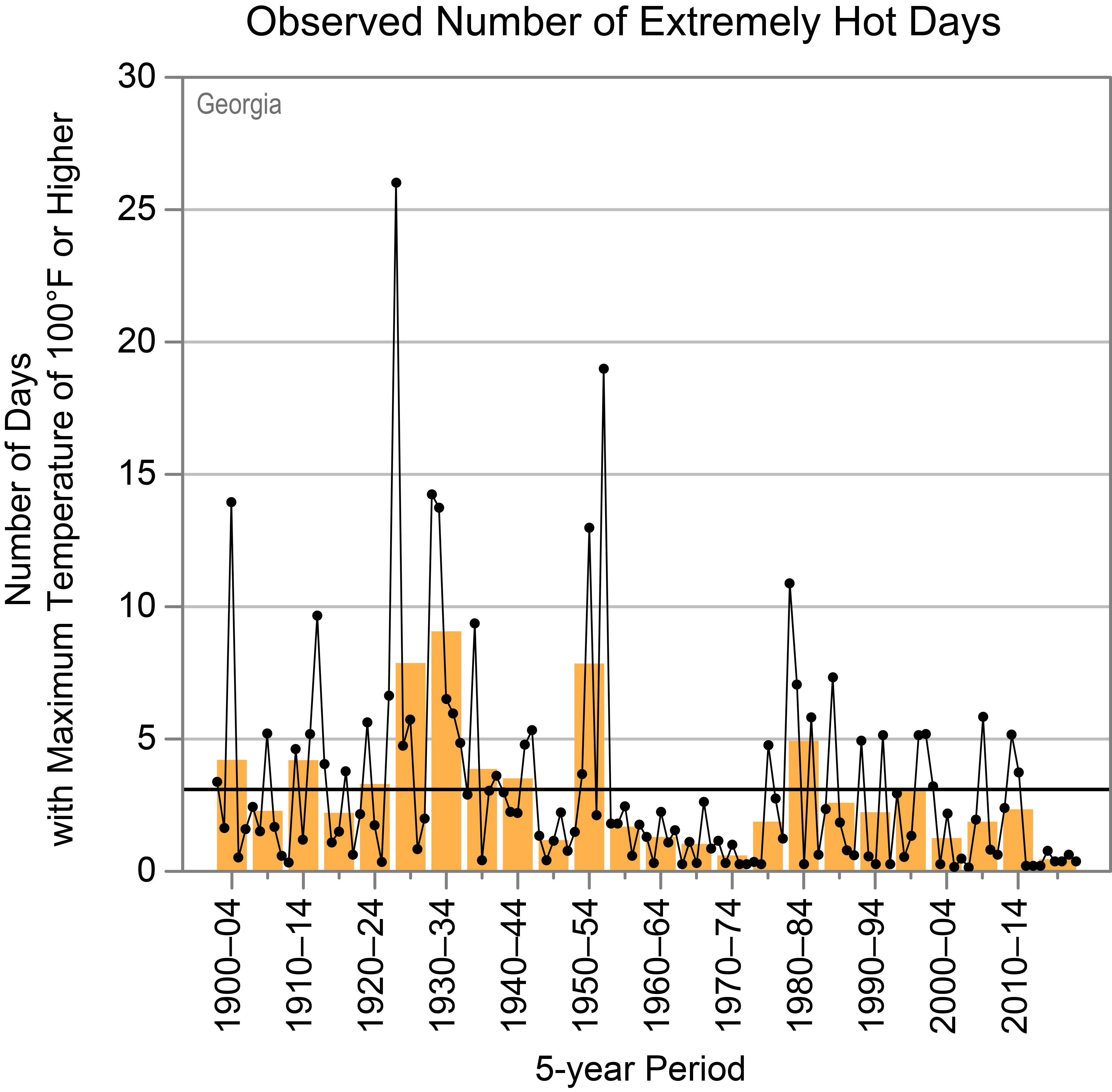
Since 1900, average temperatures have risen by just 0.8°F, which is roughly half the national average.2 This very mild rise in average annual temperature is not a result of hotter high temperatures. Indeed, the number of extremely hot days (maximum temperature 100°F or higher) has declined since the early half of the twentieth century.3 (See figure below)
Figure 1: Observed number of very hot days in Georgia since 1900. Dots are annual values. Orange bars show averages over a 5-year period, the last bar is a 6-year average. The horizontal black line shows the average of the entire period. Chart Source from Frankson, R.., et al. Georgia State Climate Summary 2022.
Instead, the average has risen due to a slight decrease in the number of frigid winter days in recent years.4 Fewer freezing nights has benefitted Georgians, because cold causes far more deaths than hot temperatures do.5
Precipitation:
There is no long-term trend in overall annual precipitation, nor in extreme precipitation events.6
Georgia is prone to occasional drought, and precipitation from year to year does vary. However, drought data show no long-term trend towards either more or fewer dry seasons.7
State-Specific Issues:
Hurricanes
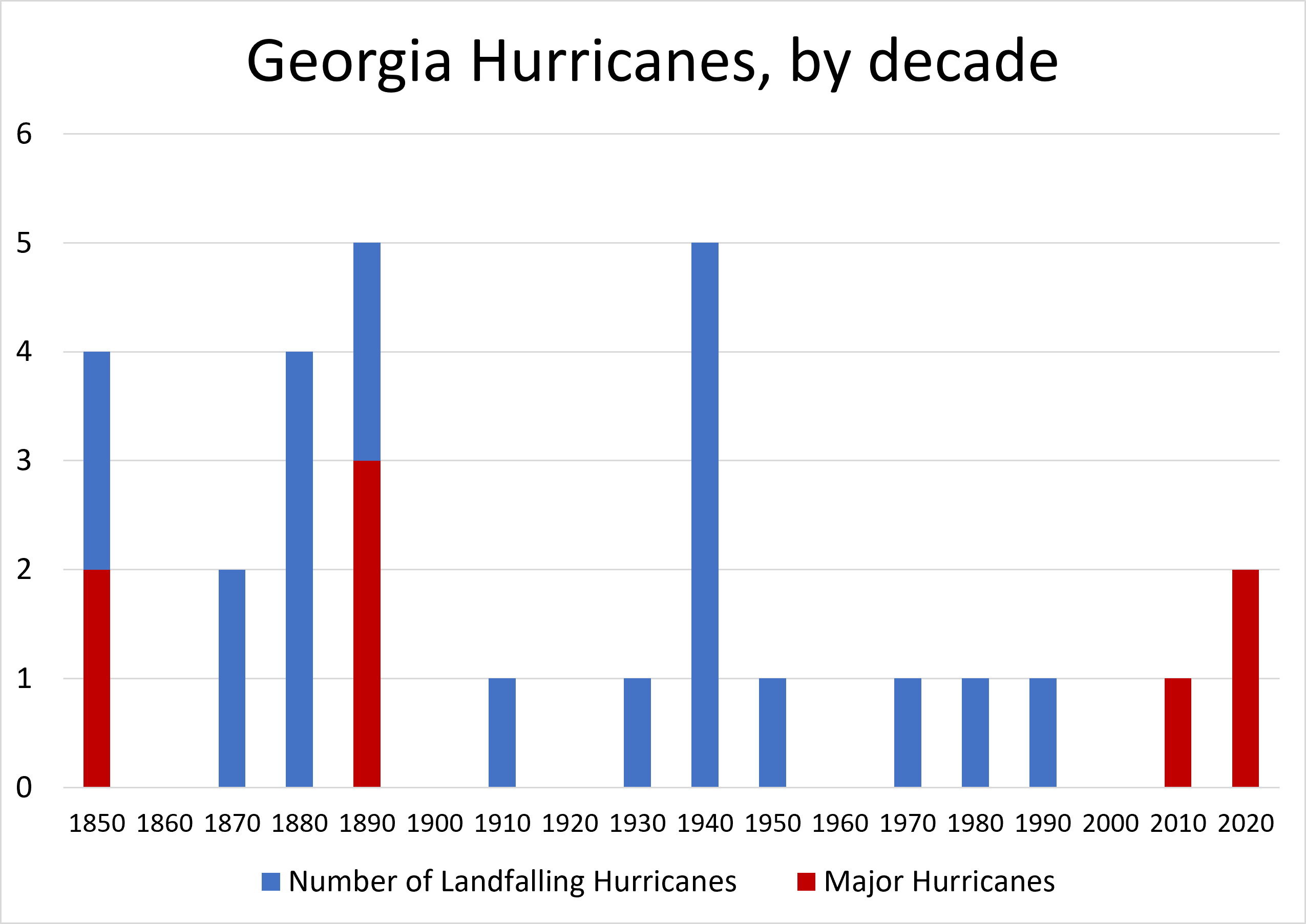
Georgia occasionally receives direct hits from hurricanes but often receives the remnants of hurricanes and tropical storms. The quantity of hurricanes striking Georgia has not increased over time. Instead, recent decades are generally quieter than the late 1800s. Nor has the quantity of major (Category 3-5) hurricanes increased.8
Figure 2: Count of landfalling hurricanes in Georgia from 1850-2025. Blue bars are total hurricanes, red parts indicate the count of major hurricanes. Data from NOAA Historical Hurricane Tracks HURDAT 2 database at https://www.climate.gov/maps-data/dataset/historical-hurricane-tracks-gis-map-viewer
Sea Level Rise
As a coastal state, Georgia sees a relative sea level rise of a modest 3.67 mm/year (0.14 inches),9 based on tide gauge measurements taken at Fort Pulaski. Relative sea level rise is not due entirely to seas rising but also land sinking. Much of the northern coast of Georgia sees around 2 mm of land subsidence per year, accounting for more than half of measured “sea level rise.”10 This is due to a variety of factors, including the marshy coastline compacting over time, dams upriver preventing sediment from replenishing coastal marshes, and groundwater withdrawals.
Wildfires
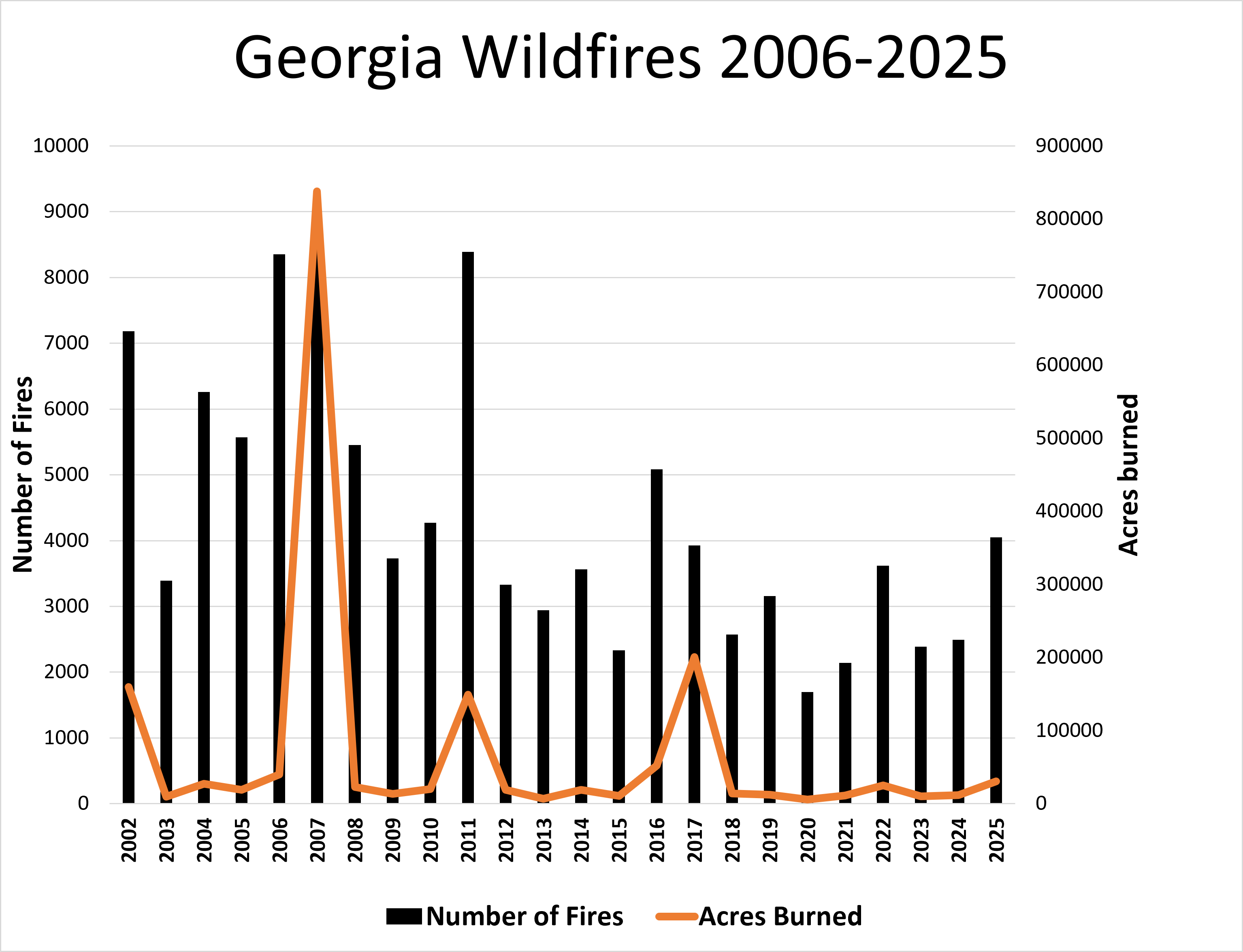
Although the state is not known for regular seasonal wildfires, they often occur during periods of extended drought. Data going back to 2002 show a trend towards fewer wildfires and less acreage burned.11
Figure 3: Wildfires in Georgia from 2002 – 2025. Data from the National Interagency Coordination Center.
Agriculture:
While Georgia is known for peaches, they are not actually the highest value crop in the state. Georgia is the number one producer in the country for peanuts and pecans and has a long history of cotton production.
Georgia peanuts have increased in yield per acre by more than 470 percent since 1909. Production has increased an amazing 11,000 percent, from a few million pounds per season to more than 3.7 billion.12
Pecans have a much shorter reporting period. But since 2018, amid a record crop (2020) and low years from hurricane losses, yields have expanded by 31 percent.13
Cotton has been grown in Georgia since the early colonial period. Since 1900, it has seen an increase in production of about 47 percent even as the acreage devoted to cotton production has declined. During the same period, the yield per acre planted has increased by more than 500 percent.14
Conclusion:
Georgia is not suffering from any climate catastrophe. Warming has been extremely mild, with no trend in days with extreme heat. Freezing temperatures, which can be dangerous to human health, have declined. The Peach State is also experiencing fewer springs frosts, which is bad for fruiting trees. With no increase in extreme weather, crop production has flourished.
Georgia has seen a decline in extreme heat, including fewer days with temperatures 100°F or higher.
Average temperatures have risen at only half the national rate.
Hurricane strikes have not increased, nor have wildfires.
Major cash crops like peanuts have seen massive increases in yields over time.
Short Summary:
Temperature Trends:
Georgia is dominated by a humid subtropical climate, according to Köppen classification. It has short, mild winters and hot, humid summers, with little difference in precipitation between seasons.1
Since 1900, average temperatures have risen by just 0.8°F, which is roughly half the national average.2 This very mild rise in average annual temperature is not a result of hotter high temperatures. Indeed, the number of extremely hot days (maximum temperature 100°F or higher) has declined since the early half of the twentieth century.3 (See figure below)
Figure 1: Observed number of very hot days in Georgia since 1900. Dots are annual values. Orange bars show averages over a 5-year period, the last bar is a 6-year average. The horizontal black line shows the average of the entire period. Chart Source from Frankson, R.., et al. Georgia State Climate Summary 2022.
Instead, the average has risen due to a slight decrease in the number of frigid winter days in recent years.4 Fewer freezing nights has benefitted Georgians, because cold causes far more deaths than hot temperatures do.5
Precipitation:
There is no long-term trend in overall annual precipitation, nor in extreme precipitation events.6
Georgia is prone to occasional drought, and precipitation from year to year does vary. However, drought data show no long-term trend towards either more or fewer dry seasons.7
State-Specific Issues:
Hurricanes
Georgia occasionally receives direct hits from hurricanes but often receives the remnants of hurricanes and tropical storms. The quantity of hurricanes striking Georgia has not increased over time. Instead, recent decades are generally quieter than the late 1800s. Nor has the quantity of major (Category 3-5) hurricanes increased.8
Figure 2: Count of landfalling hurricanes in Georgia from 1850-2025. Blue bars are total hurricanes, red parts indicate the count of major hurricanes. Data from NOAA Historical Hurricane Tracks HURDAT 2 database at https://www.climate.gov/maps-data/dataset/historical-hurricane-tracks-gis-map-viewer
Sea Level Rise
As a coastal state, Georgia sees a relative sea level rise of a modest 3.67 mm/year (0.14 inches),9 based on tide gauge measurements taken at Fort Pulaski. Relative sea level rise is not due entirely to seas rising but also land sinking. Much of the northern coast of Georgia sees around 2 mm of land subsidence per year, accounting for more than half of measured “sea level rise.”10 This is due to a variety of factors, including the marshy coastline compacting over time, dams upriver preventing sediment from replenishing coastal marshes, and groundwater withdrawals.
Wildfires
Although the state is not known for regular seasonal wildfires, they often occur during periods of extended drought. Data going back to 2002 show a trend towards fewer wildfires and less acreage burned.11
Figure 3: Wildfires in Georgia from 2002 – 2025. Data from the National Interagency Coordination Center.
Agriculture:
While Georgia is known for peaches, they are not actually the highest value crop in the state. Georgia is the number one producer in the country for peanuts and pecans and has a long history of cotton production.
Georgia peanuts have increased in yield per acre by more than 470 percent since 1909. Production has increased an amazing 11,000 percent, from a few million pounds per season to more than 3.7 billion.12
Pecans have a much shorter reporting period. But since 2018, amid a record crop (2020) and low years from hurricane losses, yields have expanded by 31 percent.13
Cotton has been grown in Georgia since the early colonial period. Since 1900, it has seen an increase in production of about 47 percent even as the acreage devoted to cotton production has declined. During the same period, the yield per acre planted has increased by more than 500 percent.14
Conclusion:
Georgia is not suffering from any climate catastrophe. Warming has been extremely mild, with no trend in days with extreme heat. Freezing temperatures, which can be dangerous to human health, have declined. The Peach State is also experiencing fewer springs frosts, which is bad for fruiting trees. With no increase in extreme weather, crop production has flourished.
We use cookies to ensure that we give you the best experience on our website. If you continue to use this site we will assume that you are happy with it.